Long Beach Circuit:

Ethnographic Research for Microtransit Innovation

Project Type: Quarter-long Ethnographic Research Study
Duration: Fall 2024 (IN4MATX 281 - User Needs Analysis)
Client: City of Long Beach & Circuit Transit
Role: Lead UX Researcher

Project Overview

The Long Beach Circuit is a free, on-demand electric microtransit service that operates iconic vehicles throughout downtown Long Beach and surrounding areas. Despite overwhelming user appreciation and high visibility, the service faces a unique challenge: they deliberately avoid advertising because they cannot meet existing demand without fleet expansion requiring additional funding.

This ethnographic research project investigated the "visibility paradox" - how Circuit's distinctive electric vehicles are highly visible throughout Long Beach, yet the service remains unknown to many potential users. Through comprehensive fieldwork, I uncovered critical gaps between current user experience and the service's potential as a model for sustainable community transportation.

Research Challenge

Primary Question: How do people discover and experience the Long Beach Circuit service, and what improvements could benefit both riders and drivers?

Context: Circuit operates as a completely free electric vehicle service that has grown from a 2018 pilot program to an expanded 2024 service covering downtown Long Beach, Belmont Shore, Bluff Heights, and extending to the Queen Mary. While users love the service, systematic app functionality breakdowns and missed community engagement opportunities suggested significant improvement potential.

Methodology

Ethnographic Fieldwork (7+ hours)

  • Contextual Inquiry: Participated as actual Circuit user while observing

  • Ride-alongs: Accompanied drivers across all service zones (Downtown, Belmont Shore, Queen Mary)

  • Vehicle Experience: Rode in all three vehicle types (accessible vans, Kia sedans, iconic GEM carts)

Stakeholder Interviews

  • Driver Interviews: 2 team lead drivers (Downtown and Belmont Shore teams)

  • Passenger Interviews: Multiple riders representing diverse age groups and usage patterns

  • Management Interview: Circuit Partnerships Manager (virtual)

Analysis Process

  • Transcription: Word-for-word interview transcription

  • Pattern Identification: Categorical analysis of user behaviors and pain points

  • Contextual Modeling: Created Day-in-the-Life, Cultural, and Workflow models

  • Opportunity Mapping: Developed prioritized recommendations based on frequency and impact of issues

Key Research Insights

1. The Visibility Paradox

Circuit's iconic vehicles are everywhere in Long Beach, leading to organic discovery through visual recognition or word-of-mouth. However, Circuit deliberately limits advertising because the service is so popular they cannot keep up with current demand without fleet expansion requiring additional funding.

"Oh, so 53% is we saw a car in Long Beach. Based on the most recent survey, 28% is friend or word of mouth." - Circuit Partnerships Manager

2. Professional Service Undermined by System Limitations

Drivers resort to homemade workarounds that compromise the service's professional image. Critical app functionality gaps force drivers to use personal resources to deliver professional service.

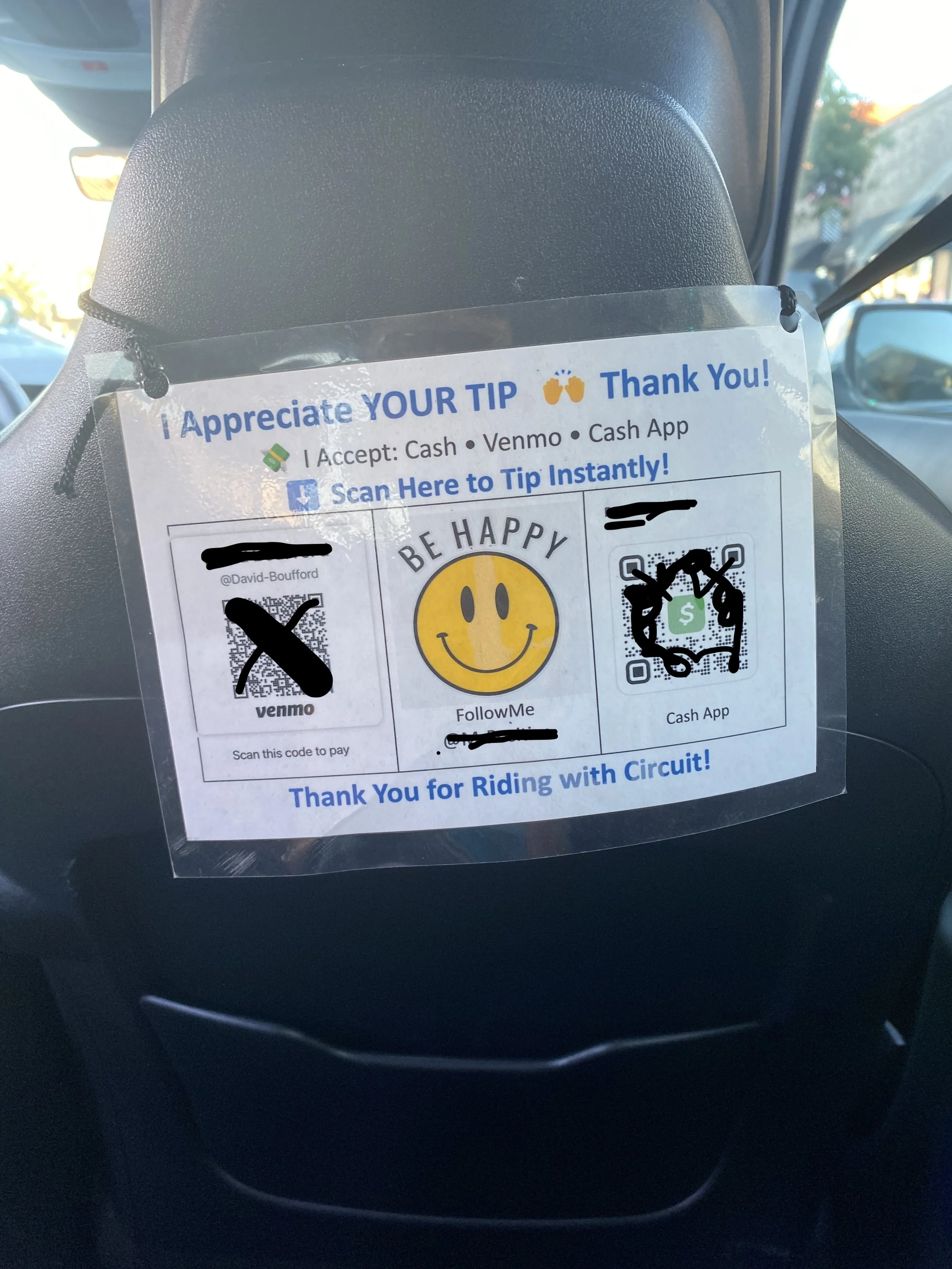
DIY Tipping Solutions: Drivers create handmade signs with QR codes because the app lacks basic tipping functionality

"I have my sign right here with like, my Venmo code and Zelle if you want to tip me through that way. And I also have a little tip jar if you want to tip that way... Well, they can't tip through our app, which again is, one of those things that I think a lot of the limitations with our app..."

Navigation Breakdowns: Drivers rely on personal phones for turn-by-turn directions

"The app doesn't give you like turn-by-turn navigation. It kind of just like drops a pin on the map somewhere and you can just like make your way towards it on your own."

3. Sophisticated User Adaptations

Users develop expert-level strategies to work around system limitations, demonstrating remarkable adaptation to constraints:

Zone Gaming: Users strategically navigate to specific zones to increase their chances of getting preferred vehicle types

"I go into the zone where you have the carts because this zone's smaller... I can walk 20 minutes into this zone, and then I was like, ooh, got one within a minute"

App Surveillance: Users must constantly monitor the app due to missing push notifications

"Sometimes it'll jump around... it'll be like, oh, it's five minutes away, and then I'll look at it two seconds later, it's like, your driver's here and I'm, like, rushing out the door."

4. Accidental Community Infrastructure

Despite system limitations, Circuit has created unexpected community benefits:

"It feels a lot more like a community than like Uber. Cuz Uber's like anyone, but like I've had him driving around before, you know, like multiple people and everyone's so nice."

Drivers develop personal relationships with regular passengers, creating a safety net and social connection that differentiates Circuit from commercial ride-share services.

Strategic Opportunities

My research identified three critical opportunity areas that address systematic pain points through strategic implementation:

Opportunity 1: Predictability & Transparency

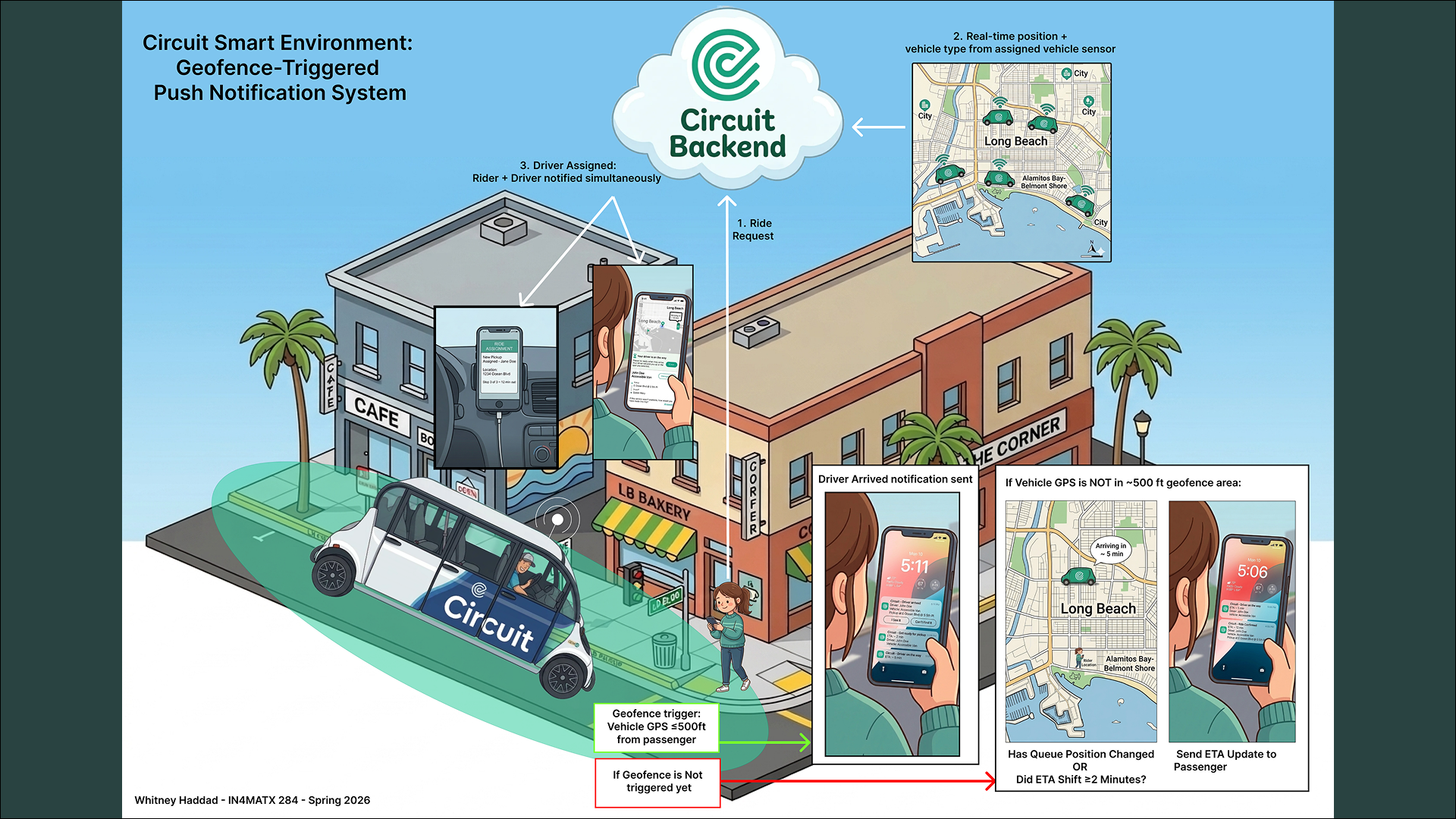
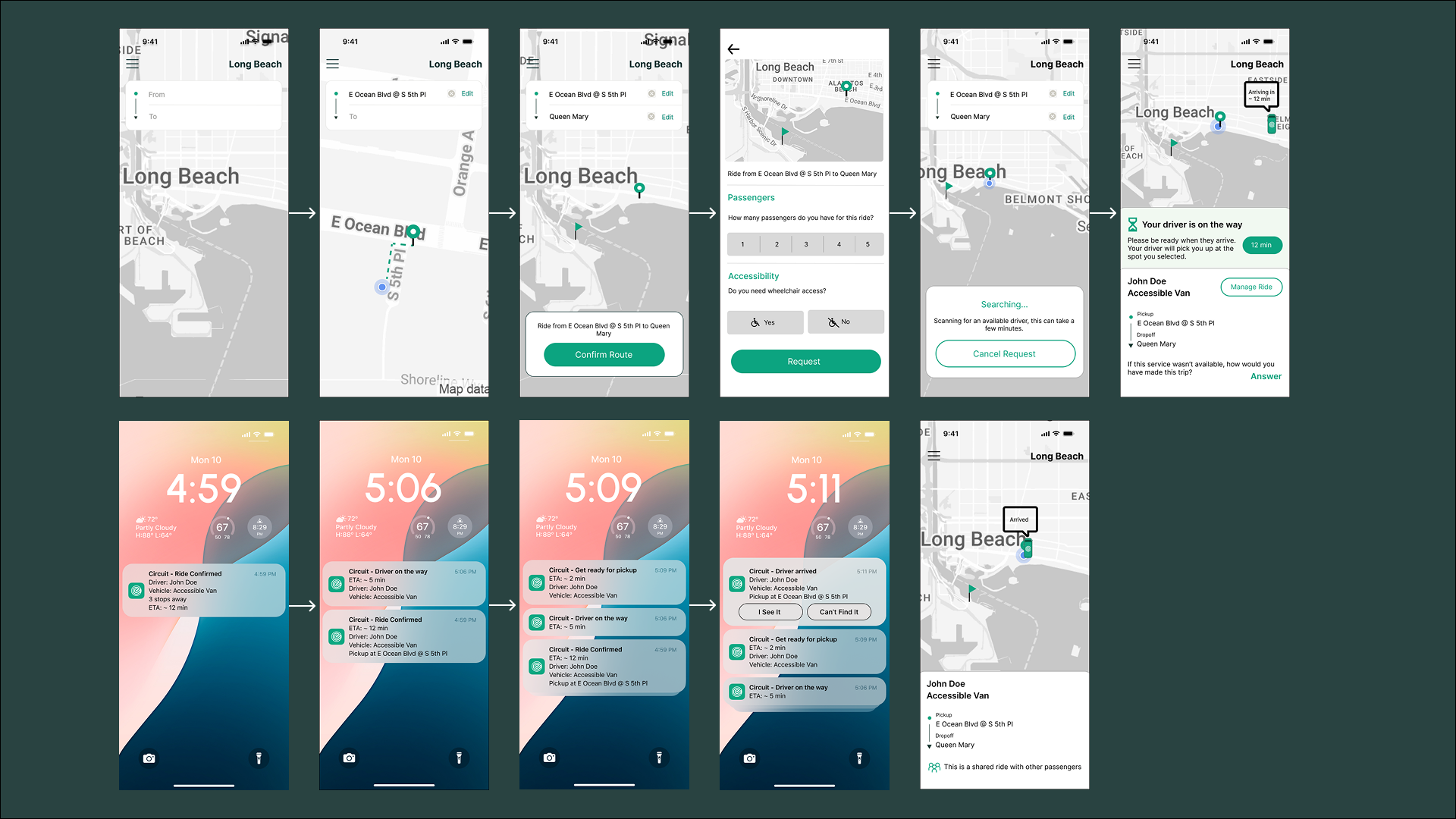
Problem: Users engage in "app surveillance" behaviors due to missing notifications and unknown vehicle types

Solutions:

  • Push notification system for ride status alerts

  • Vehicle type display showing which Circuit vehicle is arriving

  • Fleet visibility map enabling strategic pickup decisions

Impact: Eliminates user stress and improves pickup efficiency for both riders and drivers

Opportunity 2: Seamless Operations

Problem: Critical app gaps force drivers to use personal resources for professional service delivery

Evidence:

"The app doesn't give you like turn-by-turn navigation... I have my sign right here with like, my Venmo code and Zelle if you want to tip me through that way."

Solutions:

  • Integrated turn-by-turn navigation within Circuit app

  • Streamlined tipping options through payment app integration

Impact: Transforms driver workarounds into professional system features

Opportunity 3: Value Communication

Problem: Users love the free service but remain disconnected from civic investment and environmental mission

Evidence:

"How it's free, I guess I'm not sure how it's funded or where the funding comes from, but that's pretty cool."

Solutions:

  • "Did You Know?" educational pop-ups during wait times

  • Transparent communication about LA Metro Prop A funding and environmental benefits

  • Amplification of community connections that differentiate Circuit from commercial services

Impact: Fosters civic engagement and environmental awareness

Implementation Strategy

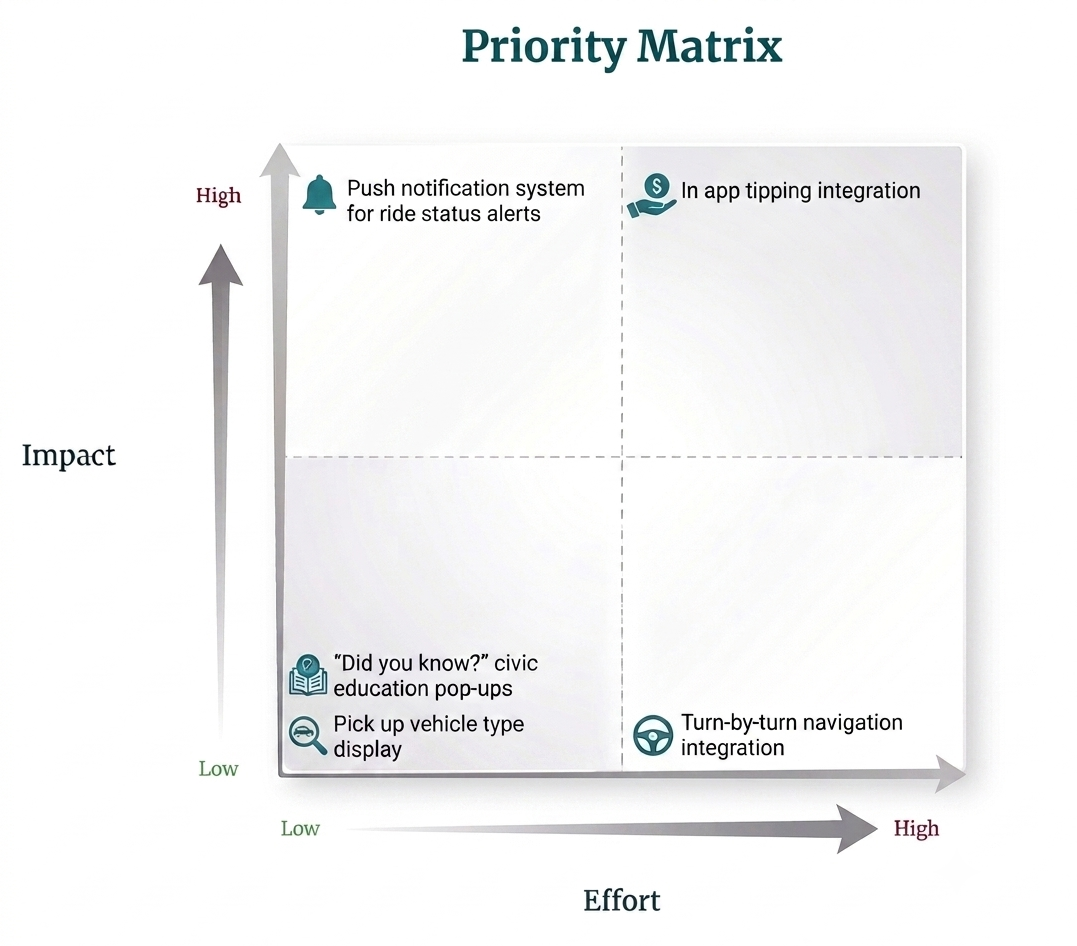
Priority Matrix Analysis

I developed a strategic implementation roadmap based on impact vs. effort assessment:

High Impact, Low Effort (Priority 1):

  • Push notification system - eliminates user surveillance behaviors

High Impact, Medium Effort (Priority 2):

  • Tipping integration and fleet visibility map

Medium Impact, Low Effort (Priority 3):

  • Vehicle type display and civic education pop-ups

Research Artifacts

Contextual Models Created

Day-in-the-Life Model: Captured how users integrate Circuit into broader life routines, revealing sophisticated planning strategies and multimodal decision-making

Cultural Model: Illuminated underlying forces shaping stakeholder experiences, including the tension between high demand and limited supply, and how community culture develops within formal service constraints

Workflow Model: Mapped systematic breakdowns across the Circuit ecosystem, showing how technical limitations force both drivers and riders to develop workaround strategies

Skills Demonstrated

Ethnographic Research Methods:

  • Participant-observation fieldwork

  • Contextual inquiry

  • Stakeholder interviews across user types

  • Cultural analysis and modeling

UX Research Analysis:

  • Pattern identification and categorization

  • Opportunity mapping

  • Impact/effort prioritization

  • Strategic recommendation development

Design Thinking:

  • Human-centered problem framing

  • Systems thinking approach

  • Stakeholder empathy and advocacy

  • Implementation planning

Research Communication:

  • Comprehensive opportunity reporting

  • Visual model creation

  • Stakeholder presentation delivery

  • Portfolio documentation

Project Impact

This research provides a roadmap for transforming Circuit from a service users love despite limitations to one that exemplifies thoughtful design creating both functional efficiency and meaningful community connection. The findings have direct applications for:

  • Municipal Transportation Planning: Understanding how to design community-centered microtransit

  • Public Service Design: Balancing resource constraints with user experience excellence

  • Community Engagement: Leveraging transportation infrastructure for social connection

  • Sustainable Transportation: Communicating environmental benefits to increase user investment

Key Learnings

Methodological Insights:

  • Participant-observation revealed user behaviors that interviews alone could not capture

  • Cultural modeling uncovered systemic tensions between policy intentions and user realities

  • Multiple stakeholder perspectives (riders, drivers, management) provided essential triangulation

Design Insights:

  • Users will create sophisticated workarounds when systems don't meet their needs

  • Community benefits can emerge organically from transportation services

  • Resource constraints require strategic prioritization but don't preclude excellent user experience

Research Practice:

  • Ethnographic methods provide depth that surveys and analytics cannot achieve

  • Real-world constraints (funding, capacity) must inform realistic design recommendations

  • Stakeholder relationships and trust are essential for accessing authentic user experiences

Files & Deliverables

  • Opportunity Report: 8-page comprehensive analysis with strategic recommendations

  • Research Presentation: 30-slide deck detailing methodology, findings, and implementation roadmap

  • Work Models: Day-in-the-Life, Cultural, and Workflow models with visual documentation

  • Interview Transcripts: Complete stakeholder interview documentation

  • Field Notes: Detailed observational data from 7+ hours of ride-alongs

This project demonstrates my ability to conduct rigorous ethnographic research, analyze complex user ecosystems, and develop actionable strategic recommendations for real-world stakeholders.